Code of Ethics
Code of Ethics
Code of Ethics
2026 Code of Ethics – Printable
Arbitration
In the event of contractual disputes or specific non-contractual disputes as defined in Standard of Practice 17-4 between REALTORS® (principals) associated with different firms, arising out of their relationship as REALTORS®, the REALTORS® shall submit the dispute to arbitration in accordance with the regulations of their Board or Boards rather than litigate the matter.
In the event clients of REALTORS® wish to arbitrate contractual disputes arising out of real estate transactions, REALTORS® shall arbitrate those disputes in accordance with the regulations of their Board, provided the clients agree to be bound by the decision.
The obligation to participate in arbitration contemplated by this Article includes the obligation of REALTORS® (principals) to cause their firms to arbitrate and by bound by any award.
(a) Every REALTOR® of the Board who is a REALTOR® principal, every REALTOR® principal who participates in a Board’s MLS where they do not hold Board membership and every nonmember broker or licensed or certified appraiser who is a Participant in the Board’s MLS shall have the right to invoke the Board’s arbitration facilities in any dispute arising out of the real estate business with a REALTOR® principal in another real estate firm or with that firm (or both), or nonmember broker/appraiser or their firm or both who is a Participant in the Board’s MLS.(b) A REALTOR® other than a principal or a REALTOR®-Associate® shall have the right to invoke the arbitration facilities of the Board in a business dispute with a REALTOR® or REALTOR®-Associate® in another firm or with their firm (or both), whether in the same or a different Board, provided the REALTOR® principal with whom he is associated joins in the arbitration request, and requests arbitration with the REALTOR® principal of the other firm or with their firm (or both). Arbitration in such cases shall be between the REALTOR® principals or their firms (or both). REALTOR® nonprincipals and REALTOR®-Associate®s who invoke arbitration in this manner, or who are affiliated with a respondent and have a vested financial interest in the outcome, have the right to be present throughout the proceedings and to participate but are not considered to be parties.
(c) A client of a REALTOR® principal may invoke the facilities of the Board in a business dispute with a REALTOR® principal or the REALTOR®’s firm (or both) arising out of an agency relationship, provided the client agrees to be bound by the arbitration. In the event of such request and agreement the Board will arbitrate the dispute subject to the Board’s right to decline arbitration based on the amount involved or the legal complexity of the dispute. A REALTOR® principal may also invoke arbitration against his client but no arbitration may be held without the client’s voluntary agreement to arbitrate and to be bound by the decision.
Circumstances under which arbitration is contingent upon the REALTOR®’s voluntary participation(a) REALTORS® and REALTOR®-Associate®s who are or were affiliated with the same firm shall have the right to invoke the arbitration facilities of the Board, provided each party voluntarily agrees to the arbitration in writing and the Board finds the matter properly subject to arbitration. This privilege as stated applies to disputes arising when the parties are or were affiliated with the same firm, irrespective of the time request is made for such arbitration.
(b) A REALTOR® principal may invoke the arbitration facilities of the Board in a dispute arising out of the real estate business with a nonmember broker, provided each party agrees in writing to the arbitration and provided the Board finds the matter properly subject to arbitration. However, it shall be optional with the member as to whether he will submit to a claim to arbitration by a nonmember broker who is not an MLS Participant. A nonmember broker who is not an MLS Participant or nonmember salesperson shall not be entitled to invoke the arbitration facilities of the Board of REALTORS®.
(c) Business disputes between a REALTOR® principal and a customer of the REALTOR® principal may be arbitrated by the Board if a written contractual relationship has been created by a REALTOR® principal between a customer and a client and provided all parties to the dispute (i.e., the customer and the REALTOR®) agree in writing to arbitrate the dispute.
Code of Ethics Requirement
Be the best REALTOR® you can be. As a REALTOR®, it’s your job to protect and promote America’s oldest core value: home ownership. And with that job, comes a duty to act with integrity and encourage excellence. REALTORS® are required to complete ethics training every three years. During each three year cycle every REALTOR® is required to complete 2.5 CE hours of Code of Ethics (COE) training in order to continue their membership with the association.
The REALTORS® Code of Ethics: click here to view the Code of Ethics
NAR Code of Ethics class options: click here to view NAR’s COE training options.
Current Cycle: January 1, 2025 – December 31, 2027
Future Cycles: January 1, 2028 – December 31, 2030
****NEW REQUIREMENT*****
2 hours of Fair Housing must also be completed during the Current Cycle: 1/1/25-12/31/27
Training MUST be completed during these established dates. Please remember to submit all course completions to the Association office for uploading purposes.
** Failure to complete training during any cycle will lead to suspension of membership**
How to: Check Your Status
You can check your status online by logging in to the GLAR Member portal. Under your name it will list if GLAR records indicate whether you have satisfied the requirement or not. You can also see the last date you have completed your COE.
1.) Go to “Member Login” at the top right of this page
2.) Log In using your user name and password
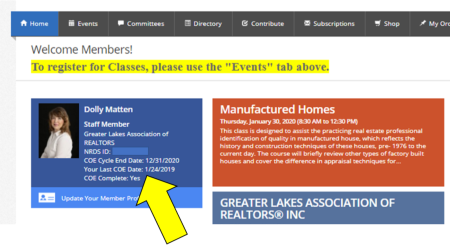
3.) Look in the blue Member Profile box on the upper left side of the page. There you will see the last
completion date we have on record for you and whether your COE is complete for this period or
not. (See screenshot below)
Alternatively, you can also check your COE status on NAR’s website by clicking the “Check Code of Ethics Status” button. If you don’t know your username/password please click on the forgot password/username link as GLAR does not store this information.
How to File an Ethics Complaint
How does the Code of Ethics affect everyday real estate practices?
If a REALTOR® represents you, whether you are buying or selling a home, you can count on that REALTOR® to:
1. Be honest with all parties in the transaction – not just with you, as his or her client, but also with the other real estate practitioner and his or her clients.
For example, if REALTORS® represent a buyer with a spotty credit history, they can’t be dishonest with sellers about this fact. At the same time, REALTORS® can help their buyer clients collect and assemble information, such as credit reports and audited tax returns, to demonstrate that the buyer has addressed the problem and improved their situation.
2. Put your interests ahead of his or her own, at all times.
A REALTOR® makes every effort to understand the housing needs of his or her client, thoroughly researches available inventory, and shares all relevant information with the buyer so that he or she can make an informed decision. This service is provided regardless of the compensation available.
3. Disclose all pertinent facts regarding the property and the transaction to both buyer and seller.
If a REALTOR® believes information provided by a seller is questionable, the REALTOR® is obligated to investigate. REALTORS® should recommend that buyers consult their own experts, such as home inspectors, to address concerns. For example, if a home seller asks his or her REALTOR® to conceal the fact that the roof leaks, the REALTOR® cannot comply; if the seller insists, the REALTOR® should end the business relationship with that seller.
4. Be truthful in all communications with the public.
When REALTORS® distribute newsletters, create Web sites, or place advertisements, they must be careful not to represent other real estate professionals’ work product as their own. If recently sold or listed properties in the community are publicized, it must be clear whether the REALTOR® was actually involved in the transaction, or whether that data came from the local multiple listing service or other source. This ensures that the public understands the REALTOR®’s experience and can make an informed decision when choosing real estate. For an overview of professional standards, please view this video.
File an ethics complaint: Minnesota Association of REALTORS®
How to Provide COE Proof of Completion
You must provide proof to your primary local association that you have completed the course between
the dates of January 1, 2021 – December 31, 2024. You can do this by:
1. Send a copy of your Minnesota CE transcript showing you have taken a Code of Ethics
class. Retrieve it from Pulse Portal and email to Office@GreaterLakesRealtors.com. (Note: if you take the FREE
class from the National Association of REALTORS®, it will not show up in Pulse Portal. There are no CE credits for the FREE CLASS.)
2. Send a copy of a course completion certificate given to you by course providers
to Office@GreaterLakesRealtors.com.
Note: If you take the class from GLAR, either as an existing member or new member, we will mark you as complete.